Insect: beetle (Coleoptera: Chrysomelidae)
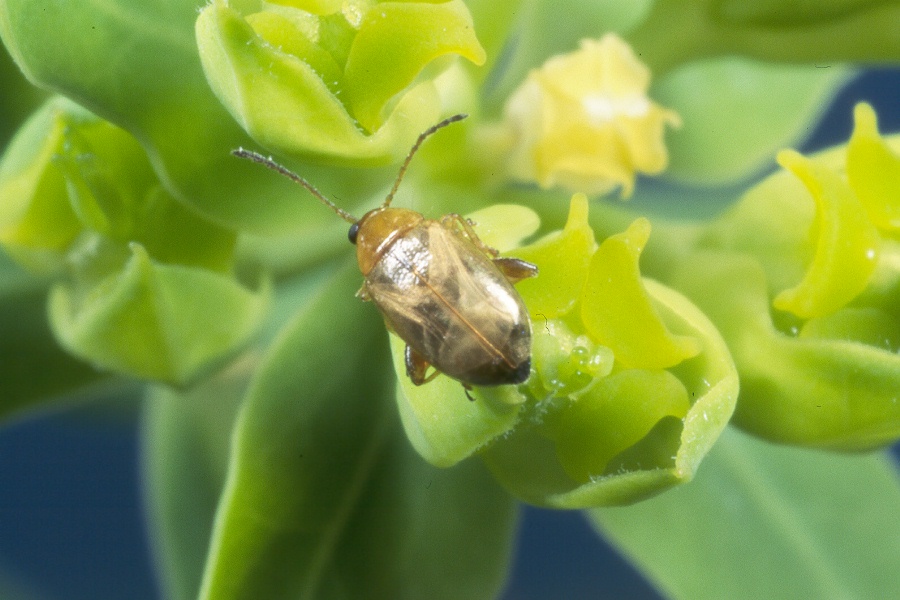
Minute spurge flea beetle
Photos: Adult 1 Adult 2 Adult 3 Adult 4
 Photo
by: Bob Richard, USDA-APHIS-PPQ. Flea
beetle on leafy spurge.
Photo
by: Bob Richard, USDA-APHIS-PPQ. Flea
beetle on leafy spurge.Original source: Europe (1)
Common Name: Minute spurge flea beetle. (1)
Type of agent: Insect: Beetle, flea beetle (Coleoptera: Chrsomelidae). (1)
Egg stage: The eggs are laid singly or in clusters of two-six on or near the plant close to the soil surface anytime from April until October. Females lay as many as 100 eggs which require three to six days of incubation during ideal conditions or up to 16 days under harsh conditions. The eggs require high relative humidity to survive. (1)
Larval stage: There are three larval instars. The larvae feed on young roots, root buds, and subterranean shoots. These larvae are elongate and have prominent head capsules. (1)
Pupal stage: The pupil stage lasts 10 to 11 days within the soil. (1)
Adult stage: Adults appear to live for 40 to 55 days, and those that are alive in December in Italy (generally forth generation) begin diapause. The adults usually hide among plant (soil) duff and under stones and branches on the soil. This species is more gray to straw-colored than the other Aphthona species. The head, prothorax and mesothorax are reddish-yellow and the abdomen and metathorax are black. This species is also relatively small, measuring an average of 2.0 mm (0.08 in) long by 1.0 mm wide. The outer pair of wings is transparent and straw-colored. (1)
Effects: unknown
Destructive stages: Adult and larval. The larva have the greatest effect on the plant.
Plant species: Leafy spurge, (Euphorbia esula). (1)
Damage to host: The adults eat the leaves and the larvae eat the root hairs and young roots of leafy spurge. (1)
Host impact: The larvae attack the roots, shoots, and shoot buds, and this reduces the rate of water and mineral intake. While this is happening down under the soil, the adults are attacking the youngest leaves at the tip of the plant, this makes the chances smaller for the plant to make sugar to help the roots. (1)
Releases: You would need to release them in a more moist spot than Aphthona nigriscutis but drier than A. czwalinae. The best climates are those that receive between 30.5 and 45.7 cm (12 and 18 in) of rain per year and have high relative humidity during the egg stage. You shouldn't put them in heavy clay soil. (1)
How and where to collect, transport, and release: You can collect them wherever they are well established. You can buy them from commercial biocontrol providers. You can find more information from your county weed coordinator or county extension agent. Once you collect them put them in a container with enough air flow. For short transport, leave them in the sweep net or put them in a paper sack and staple it shut. For longer transport you can put them into a paper ice-cream container and put it in a cooler with an ice pack but make sure that the ice pack is not touching the sides of the ice cream container or they might freeze and die. Also, you can put them in a refrigerator. (2)
Links:
Cornell University bio control
Bio control pictures
leafy spurge
leafy spurge control using flea beetles
Aphthona
pics of Aphthona
Aphthona abdominalis
Adult stage
fact sheet
Female and Male
Literature Cited:
(1) Rees, Norman, et, al., Ed., Biological Control of Weeds in the West, Western Society of Weed Science, in cooperation with USDA, ARS, MT Dept. of Ag, and MT State Univ., Bozeman, Color World Printers, Bozeman MT, Feb., 1996.
(2) Breitenfeldt, Todd, Personal Interview, Biology Teacher, Whitehall High School, P.O. Box 1109, Whitehall, MT, 59759. (406) 287-3862, email: tbreit@whitehallmt.org.
By: Mandy Choquette 1.25.02 Updated By: Trista Zink 4.17.05, Sari Dersam 6/16/16
mtwow.org HOME Back to Biological Control