Nanophyes marmoratus
Seed Weevil
(Coleoptera: Curculionidae)
Photo by: USDA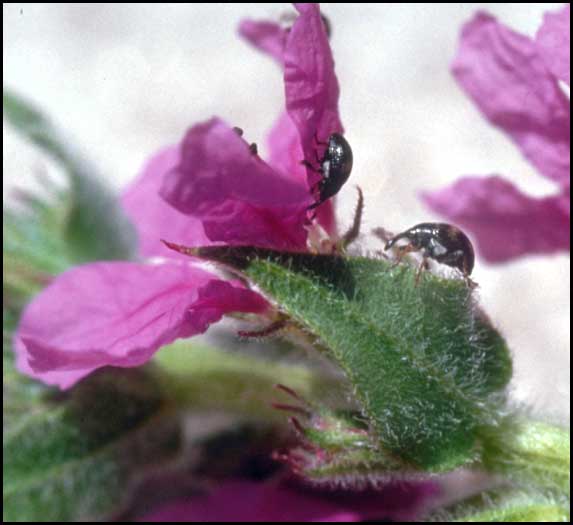
Origin: Through out Europe and Siberia, (1)Life Cycle:
Over wintering stage: Adults in stems above ground. (1)
Egg: Normally a single egg is laid into the tip of young flower buds. One to two eggs a day are laid. (1)
Larva: A single larva develops in a flower bud where it consumes the stamens, petals and ovary. Most buds fall off the plant before larval development is complete, but larval development continues. (1)
Pupa: Formed in a chamber of debris inside the attacked bud.(1)
Adult: Emerges to feed initially on young leaves and later on flower buds, which abort and drop. Egg to adult development takes a month and they feed on loose strife leaves until fall.(1)Damage to Host: Eats stamens, petals, and ovary causing the flower to die.(1)
Host Impact: Flower buds fall off as the result of adult feeding. In Europe about 30% of the remainder are destroyed by larvae. (1)
Favorable/Unfavorable Release Habitats:
Favorable- any environment infected with purple loose strife (1)
Unfavorable- unknown.How to collect: Sweep net adults when they appear on the young shoots in spring. (1)
How to redistribute: After collecting, redistribute by scattering through infected area, equally distribute the weevil throughout the infected area so that all the purple loose strife will be exterminated. (1)
Where and how to purchase: You can get information on costs and supplies by going to www.bio-control.com, or calling 1-800-334-9363. (1)
Note: not recommended in Montana as we do not have enough puple loose strife to warrent using bio-control. Small weed infestations should be COMPLETELY controlled using other methods. Mr. Breitenfeldt, 2009.
Links:
1) http://www.invasive.org/weeds/loosestrife/ch2nanmar.html
2) http://www.invasive.org/browse/detail.cfm?imgnum=0002035
3) http://www.dnr.state.mn.us/invasives/aquaticplants/purpleloosestrife/biocontrol_nm.html
4) http://www.bioimages.org.uk/HTML/T128678.HTM
5) http://www.hort.uconn.edu/ipm/general/biocntrl/looseposter4.pdf
6) http://www.entomology.wisc.edu/mbcn/fea501.html
7) http://www.hort.uconn.edu/ipm/general/biocntrl/lspstr4.htm
8) http://www.oregon.gov/ODA/PLANT/WEEDS/bio_profile_nama.shtml
9) http://zipcodezoo.com/Animals/N/Nanophyes_marmoratus/
10) http://agclass.canr.msu.edu/mtwdk.exe?k=default&l=60&w=54333&n=1&s=5&t=2
Literature Cited:
1. Malecki, R.A., S.D. Hight, D. Schroeder, 1993. Biological Control of Purple Loose strife (Lythrum salicaria L.): Introduction and field release of Nanophyes marmoratus and N. brevis, two additional control agents of purple loose strife. Petition for Environmental Assessment. Plant Protection and Quarantine, APHIS, USDA. 23 pp.
By: Zach Davis 2-26-02. - Updated By: Coty and Ryder, 3/2009.
Back to Biocontrol mtwow.org HOME